Religion and Non-religion in South Asia: Belief and Practice during Post-Secularism
Venue
New College. School of DivinityUniversity of Edinburgh
Media
Image
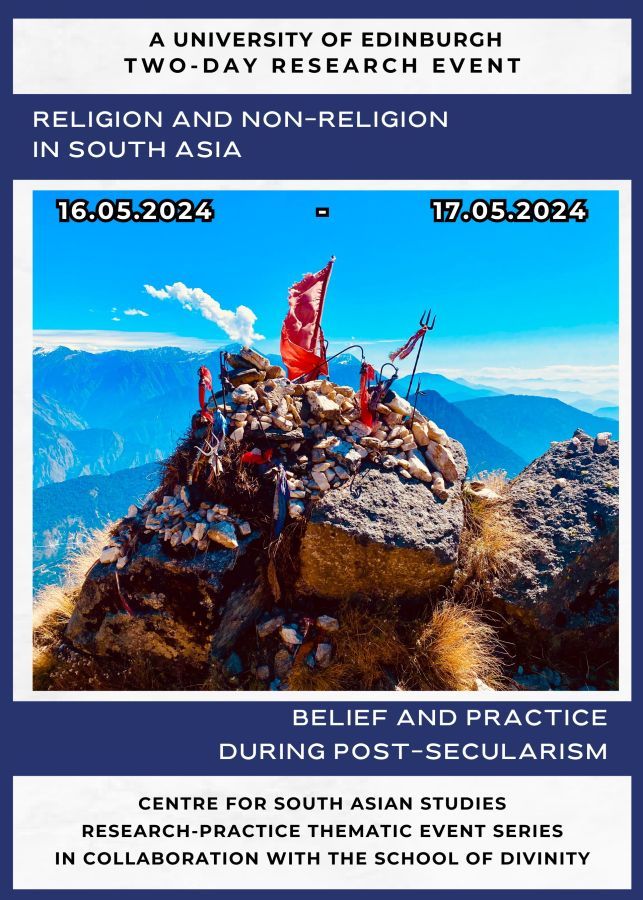
Description
We live in an age of post-secularism, where the dichotomy between the religious and the secular has become problematic (Crockett 2018; Habermas 2008; Braidotti 2008). Due to the religious roots of modernity, secularism and modernity sit at odds with each other (Taylor 2007); however, the principles of secularism continue to inform contemporary political discourse that is utilised to conduct, justify, or influence socio-cultural action. In the South Asian context, religion is a vital component of everyday life and also constitutes an important political discourse around majoritarianism that challenges the seemingly secular characteristics of the modern state and society (Gould 2012). Therefore, we need a more sustained and deeper understanding of the social and political underpinnings of religious formations to fully appreciate their complexities (Turner 2010; Casanova 1992).
The religious landscape in South Asia encompasses Buddhism, Christianity, Hinduism, Islam, Jainism, Sikhism, Zoroastrianism, and various indigenous and folk traditions. At the same time, it is also home to nonreligious and atheist movements, influenced by rational, anti-caste, and anti-superstition values. Amidst such diversity, some of the most widespread conflicts in the region have arisen due to differences in religious beliefs and practices enabled and supported by the state (Ganguly 2008; Juergensmeyer 2020). The principles of secularism have increasingly become side-lined in the region (Madan 1987), prompting a reassessment of the concept (Iqtidar and Sarkar 2013).
Given this, we ask, how are the dynamics of religion and nonreligion negotiated in South Asian society and politics? How do religious beliefs intersect with social identities and state processes in physical and digital spaces? How is majoritarian religious discourse challenged? How are religious texts interpreted and acted upon in the present context? What precipitates the making of political religion in the context of nationalist-influenced history writing? By asking these questions, we hope the seminar contributes to unravelling the less visible modes of the interplay between religious belief and practice in the current socio-political climate of South Asia. We welcome papers from scholars working in South Asia, including Afghanistan, Bangladesh, Bhutan, India, Maldives, Myanmar, Nepal, Pakistan, and Sri Lanka.
For the complete programme, please click on the link below: